playlist
BRAVE 102
Overview: A youth leadership class for BRAVE 101 graduates.
Content
B102: Lesson 1
Welcome to BRAVE 102, a role model system for high school leaders.
B102: Project 1
Let's bring some HOPE to your fellow classmates by recruiting young "superheroes" to join your "Smile Crew!"
B102: Lesson 2
Our first unit is about reconnecting with your B.R.A.V.E. group and refreshing everyone on the basics of Circle practice.
B102: Lesson 3
Our Circle process ALWAYS starts with motion. We must have fun first, rather than withholding the possibility of fun until the end.
B102: Lesson 4
Every spiderweb begins the same way — with the Bridge, a single thread that is the foundation of Circle.
B102: Lesson 5
Let's look at the first two guidelines: no talking without the Talking Piece, and maintaining one direction all the way around the Circle.
B102: Lesson 6
Now we'll cover the last two guidelines we use in every Circle: Passing is okay, and what's said in Circle stays in Circle.
B102: Lesson 7
After your guidelines have been established, it’s time to get to the real work in our spiderweb creation. This starts with our Connection Questions and the Radius Lines.
B102: Lesson 8
When asking your Connection Questions, this is where the real "weaving" of the Circle begins with what we call the Guide Wire and Auxiliary Spiral.
B102: Lesson 9
An Activator is the opening ceremony of a Circle, and we typically recommend that you symbolically or ritually close a Circle in some way as well.
B102: Project 2
It's time to start facilitating Circles with other peers and teachers in your school who are not currently enrolled in the leadership program.
B102: Journal 1
1) Summarize concepts you learned in B101 – H.O.P.E., Action, Leadership, Play. 2) What does it mean to YOU to be a Circle “Weaver”? How does it relate to the core values of Circle? 3) Identify the 4 guidelines of Circle and explain why each is important. 4) Explain the role and importance of effective Connection Questions. 5) How do YOU encourage Circle participants to share meaningfully in Circle? 6) What does “compassion” mean to you? How do you demonstrate compassion in Circle?
B102: Lesson 10
Our second unit takes us through a leadership course we call “Why Superheroes Paint Their Nails.”
B102: Project 3
As we dive into “Why Superheroes Paint Their Nails,” work on developing YOUR core values and creating a physical reminder.
B102: Lesson 11
Before we dive into core values, let's refresh on the 3 components of leadership: Influence, Environment, and Behavior Modeling
B102: Lesson 12
The "Red" lesson reminds us that we must reflect on the behaviors and actions we tell others to do, but don't adhere to ourselves.
B102: Lesson 13
The "Blue" lesson emphasizes the importance of using technology responsibly as leaders in the social media world.
B102: Lesson 14
The "Black" lesson discusses the importance of paying attention to the well-being of those around you by observing their behaviors.
B102: Lesson 15
The "Green" lesson reminds us that our biggest mission is to give H.O.P.E. to the hopeless and to show others how to do the same.
B102: Lesson 16
The "Gold" lesson covers the two most fundamental and core human needs we all share: the need for meaning and acceptance.
B102: Lesson 17
The "Pink" lesson shows us that we've all learned how to apologize and forgive the wrong way and how we must reorient our mindset.
B102: Lesson 18
The "White" lesson summarizes a key point: none of these lessons matter if we aren't willing to commit to them daily.
B102: Journal 2
1) What do the 3 components of leadership mean? How do they relate to Superheroes painting their nails? 2) Explain how leadership is about learnable strategies rather than innate talent. 3) What does behavior modeling teach us about integrity and hypocrisy? 4) Explain the lasting power and responsibility of words and actions. 5) How does the H.O.P.E. Theory guide empathy for someone feeling hopeless? 6) What are significance and acceptance, and why do humans need them?
B102: Project 4
Transitioning into our play and SEL unit, we start with a self-awareness quiz that you must complete with a partner.
B102: Lesson 19
Empathy is the foundation of human society. Without empathy, we wouldn't be able to collaborate or cooperate. Empathy is what gave rise to civilization itself.
B102: Lesson 20
Now that we understand the importance of empathy, it's essential to know what strengthens and weakens it. The best place to build empathy is in play, particularly sociodramatic play.
B102: Lesson 21
The Five Core Human Skills for life are the groundwork for successful human development. All five skills are central to B.R.A.V.E., Circle, and our play scenarios, Bully Drills.
B102: Project 5
Identifying superpowers to use in Bully Drills can be challenging, so let's practice creating some powers with a fun twist!
B102: Journal 3
1) Define empathy and how to strengthen/weaken it. 2) How do reduced play and more screen time lower youth empathy? 3) Detail the 4 Empathy Killers and their Activators. 4) Define the Five Core Human Skills. 5) How does comparing self vs. other perception build self-awareness? 6) What are your personal strengths, and how can you apply them to difficult situations? 7) What is the most interesting thing you learned about Empathy and the Human Skills? How can you incorporate them into your daily life?
B102: Lesson 22
The Feynman Technique is a method for mastering complex ideas and clearly communicating them by simplifying them enough to explain to a child.
B102: Final Project
With our final project, we'll revive your Bully Box from B101 and dive deeper into Rewinding the Tape with the Bully Tapes!
B102: Lesson 23
Bully Drills are the most effective practice for empathy and human skills. Harnessing the power of play, Bully Drills are designed to practice dealing with challenging, stressful, and awkward situations.
B102: Lesson 24
Before your first Bully Drill sessions, let's review the Gathering process.
B102: Jounral 4
1) Explain the Feynman Technique in your own words. Did it work for you? 2) Explain the structure and purpose of Bully Drills. What is the B.E.S.T. framework and what value does it serve? 3) Explain how practice through play builds a “challenge mindset.” What IS a challenge mindset? 4) Summarize your experiences designing and running Bully Drills. What did it mean to you? 5) Explain C.A.P.E.S. and how it is used in the Gathering Process.
B102: Lesson 25
Discover why self-control — not speed or smarts — is the brain’s secret weapon for learning, success, and human survival.
B102: Lesson 26
Explore the brain’s three essential skills that power thoughtful decisions, strong relationships, and real-world success.
B102: Lesson 27
Explore why teens often act on impulse as their brains struggle to balance powerful emotions with growing self-control.
B102: Lesson 28
Teen risk-taking stems from brain development and a vital need to belong and be valued.
B102: Lesson 29
Learn how better sleep boosts your brain, mood, and academic success.
B102: Lesson 30
Regular physical activity is essential for brain health and mental well-being, boosting memory, focus, and mood, and reducing depression and anxiety.
B102: Lesson 31
Screens can boost empathy and brainpower, but too much time online can overwhelm teens, weaken focus, and fuel rising anxiety.
B102: Lesson 32
Mindfulness and Landing Techniques help you stay calm and in control when emotions take off, so you can make better choices, reduce stress, and build a stronger brain for life.
B102: Journal 5
1) Explain the Executive Function and its three components as you understand them. 2) What are the “dual systems of the brain” and how do they interact? 3) How does Empathetic Fitness relate to Maslow’s Hierarchy of Needs? Can we develop EF if we are stuck at the bottom of the pyramid? 4) Explain how sleep, exercise, and screen time each impact brain health. 5) Explain how to apply mindfulness and Landing Techniques in order to perform emotional self-regulation.
Skills Developed
SEL Core Competencies, Character Development, Brain Health; Leadership, Autonomy, Empathy, Perspective-Taking, Compassion, Play, Wonder, Questioning, Behavior Modeling, HOPE, Action, Compassion, Courage, Helping Others
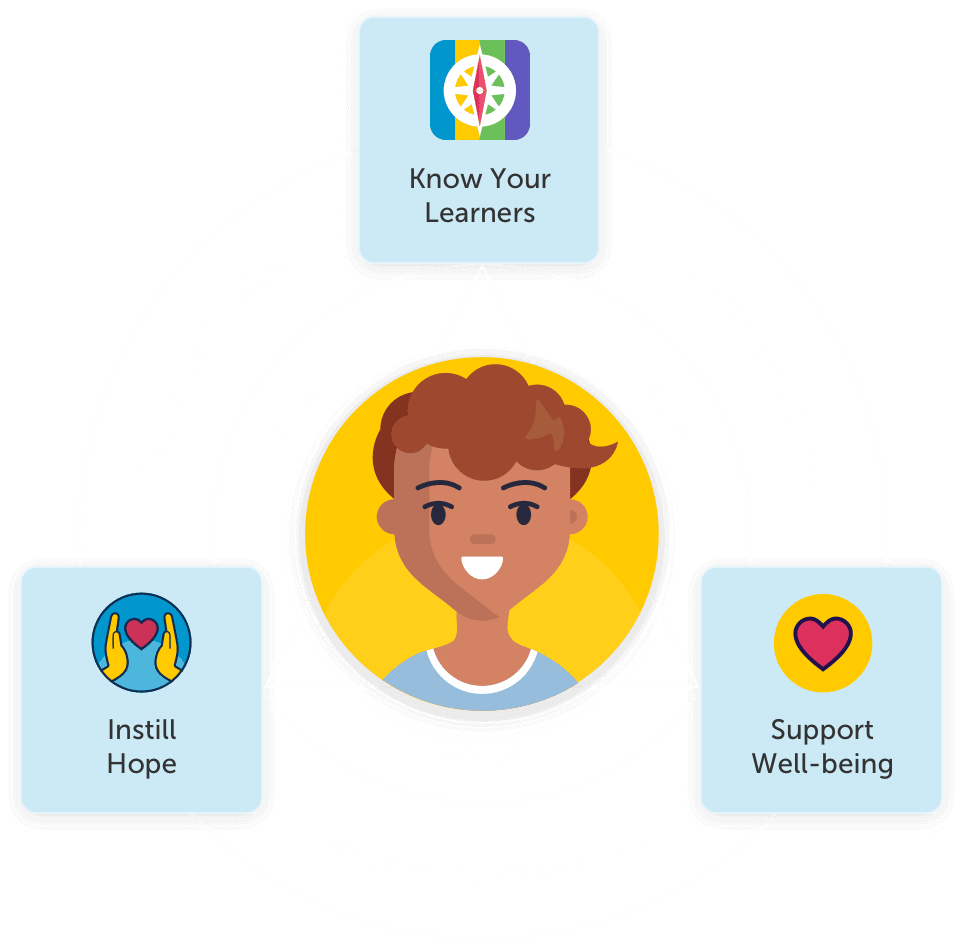
Build a Thriving Learning Community
Every learner deserves to be known, their well-being supported, and hope instilled in them no matter their circumstances.
Schedule a Call Today